
Which Walnut Public Records Open
Walnut public records are not kept in one city database. The custodian depends on who made the record. Walnut City Clerk holds council minutes, resolutions, ordinances, claims, local election files, and municipal requests. Los Angeles County offices hold deeds, assessment rolls, court cases, county vital certificates, voter files, and jail data. State agencies add business entities, licenses, prison records, and statewide certificates.
| Walnut record set | Official keeper | Online route | Access channel |
|---|---|---|---|
| City minutes, ordinances, claims, permits | Walnut City Clerk or issuing department | No full city index | Phone, email, counter, or request form |
| Deeds and liens | LA County RR/CC | No official internet index | Norwalk appointment and name/year index |
| Civil, probate, family, small claims | LA Superior Court | CivilIndex | Paid name search; Archives for older files |
| Assessment and parcel maps | LA County Assessor | Assessor Portal and Map Search | Free web tools and office records |
| Birth, death, marriage | LA RR/CC or CDPH-VR | Application, not an open certificate index | Authorized or informational copy rules |
| Jail and prison custody | LASD, CDCR, or BOP | Agency locators | Web search and agency assistance |
Open access does not mean every detail appears on the web. Juvenile, adoption, sealed, and protected-person files can be closed. Military discharges, confidential marriages, voter contact fields, victim data, and active law-enforcement material also carry limits. The federal Driver's Privacy Protection Act restricts motor-vehicle personal data.
Walnut Records Split Three Ways
Walnut is not the Los Angeles County seat. That fact shapes nearly every request. City Hall is the right place for municipal acts and local development files, but the county-first trail leads to the Registrar-Recorder/County Clerk, Assessor, Superior Court, and Sheriff's Department. California agencies become the custodian when a record is statewide.
The split is practical, not merely administrative. A Walnut planning file may name an owner, applicant, agent, or contractor, while the deed behind that parcel remains in Norwalk. A city incident is served by the LASD Walnut/Diamond Bar Station because Walnut has no municipal police department. A statewide professional license belongs to the issuing California board, not City Hall.
Use the record's origin to choose the channel. Sending a deed request to the Walnut clerk or a council-minutes request to the recorder only adds delay.
Note: Walnut records geography moves from city municipal files to county record systems and then to state databases when jurisdiction expands.
Walnut Deed Records Stay Offline
The biggest local quirk concerns recorded real estate. The RR/CC real-estate viewing page says Los Angeles County maintains records from 1851 but does not place its official real-estate records or indexes on the internet. Records from 1851 through 1957 are reviewed on the lower level at Norwalk headquarters. Records from 1958 forward are on the second floor. Appointments may be booked up to two weeks ahead, and the office does not perform index searches by telephone.
That official notice is important because it distinguishes access from convenience. The index is public at the office even though it is absent from the open web.
| Index element | Format | Required | Official access note |
|---|---|---|---|
| Name and year | Alphabetical in-person index | Yes | Organized by party name and year recorded |
| Record date | Floor-location rule | Yes | 1851-1957 lower level; 1958-present second floor |
| Appointment | Scheduled visit | Yes | May be set up to two weeks ahead |
| Internet search | None | Not applicable | No official online index or image access |
A grantor transfers an interest, while a grantee receives it. Searchers can first use parcel tools to identify the land, then check both names in the recorder's year index. Known documents may be ordered under the RR/CC copy rules, but an unknown party search still requires office index work.
Walnut Court Records Run Online
The recorder's offline index contrasts with the LA Superior Court CivilIndex. That paid name search covers litigants in unlimited civil, probate, and family matters from 1983, limited civil from 1991, and small claims from 1992. Results state the litigant name, case type, filing date, filing location, and the number of available imaged documents. The court says the index is updated daily.
The interface provides remote name access, but each search carries a public-access fee. Registered users use a sliding scale, while guests pay a flat search rate.
A docket is the court's chronological case activity list, not the full case file. When a Walnut matter predates online coverage or a case number is unknown, the Archives and Records Center can help locate archived files and process mail, copy, or certification requests.

The Archives route preserves access when the online date range ends. Sealed, juvenile, adoption, and confidential material remains unavailable regardless of the channel.
Walnut Property Records by Parcel
The LA County Assessor Portal and its Map Search are the web starting points for a Walnut address. Official material confirms search by Assessor Identification Number, called an AIN, or by address. The GIS map connects parcel boundaries with location context. Exact field lists and an online owner-name option were not verified, so those features should not be assumed.
The AIN or street address matters before recorder research because it supplies a parcel key that can be carried to the deed index. The LA County Property Tax Portal then links Assessor, Auditor-Controller, Treasurer and Tax Collector, and Assessment Appeals information.
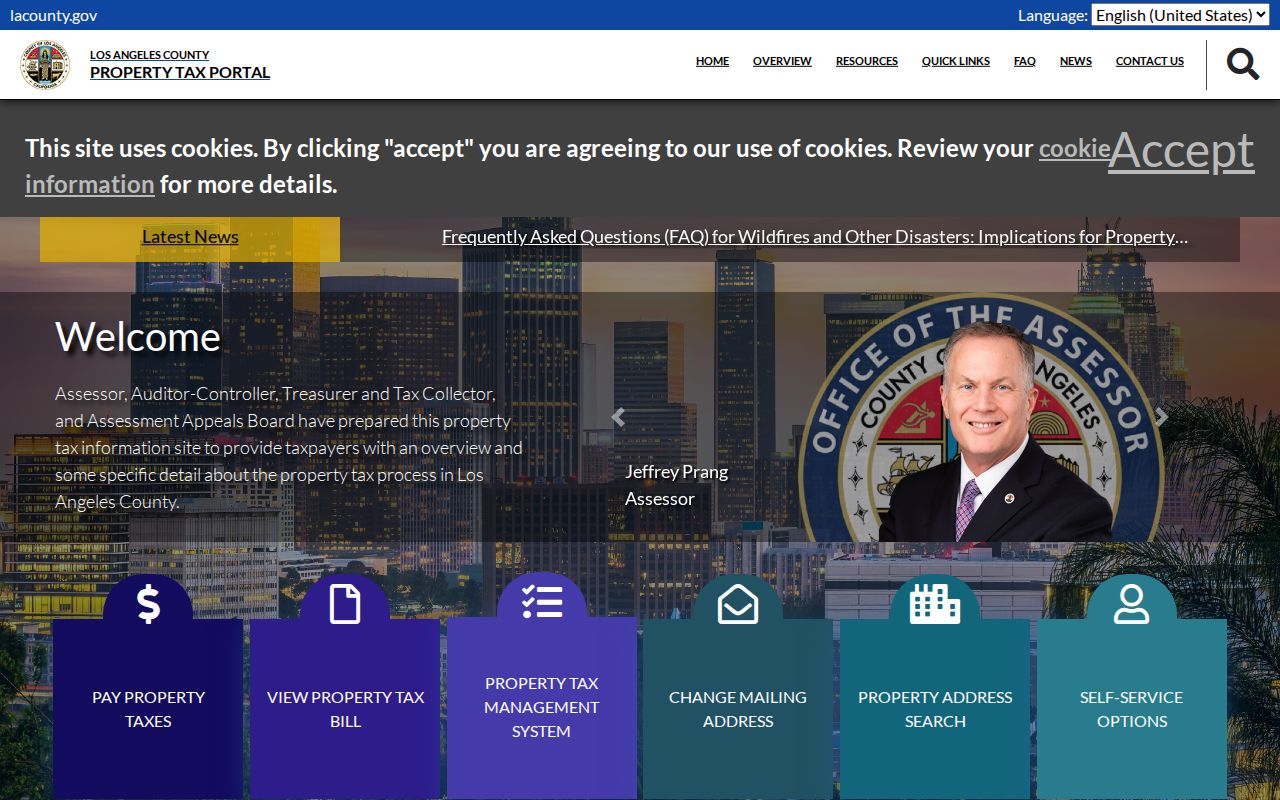
The captured cross-office portal shows why assessment, tax, and recorded-title records should not be treated as one database. Walnut building and planning files add another layer: inspection requests use project address, contact information, and inspection type, while planning applications may carry owner signatures and applicant materials. Active enforcement and private details may be redacted.
Walnut Vital Records Copy Rules
Los Angeles County RR/CC issues county birth, death, and marriage copies; California Department of Public Health Vital Records handles statewide records. Under Health and Safety Code section 103526, an authorized certified copy can establish identity, while an informational certified copy is marked as invalid for that purpose. Authorized copies are limited to eligible people and agencies. Confidential marriage copies go only to a spouse or someone with a court order.
The LA County vital-record application uses Application, Customer, Certificate Information, and Submit steps. Same-day availability covers births since 1962 except 1972-1977, deaths since 1995, and LA County-issued marriages since 1995. Older county ranges use mail or office workflows: birth from 1866, death from 1877, and marriage from 1852. The requester must visit an RR/CC office with the confirmation number, valid photo identification, and payment.
That application reflects a certificate-order process, not an open people index. LA County lists birth copies at $34, death at $26, and marriage at $19. Payment is nonrefundable, and a failed search produces a No Record Statement.
Copy warning. Same-day service does not cover every year or informational copy. Confirm the record range and eligibility before visiting an office.
Walnut Public Safety Records Channels
Local incident and police-record requests go through the LASD Walnut/Diamond Bar Station, 21695 E. Valley Boulevard, Walnut, CA 91789, at (909) 595-2264. The station serves Walnut, Diamond Bar, Rowland Heights, and nearby unincorporated areas. Active investigations, victim details, juvenile information, and sensitive reports may be withheld or redacted.
Current county custody uses the LASD Inmate Information Center. It warns that bookings from the last two hours are not available; custody-location help is available at (213) 473-6100. The exact live search fields and result inventory were not captured, so no unsupported field list is presented.
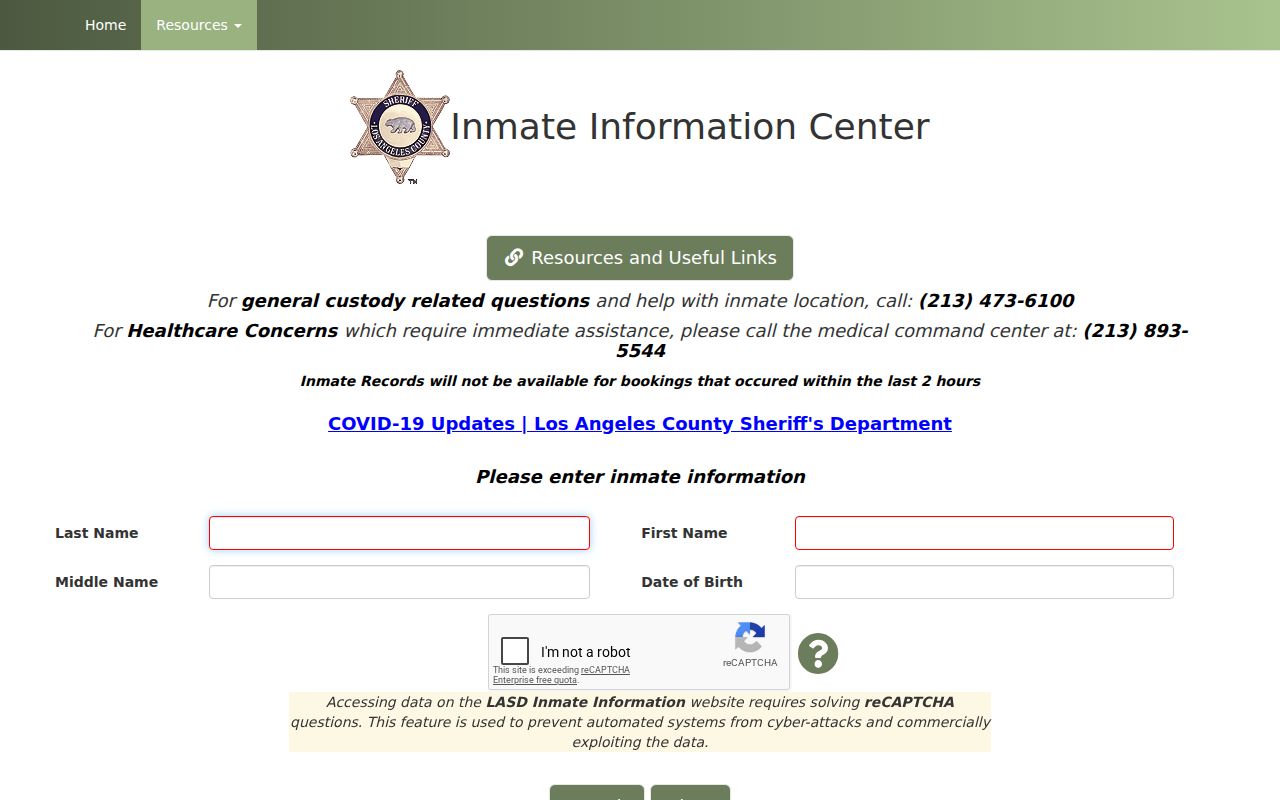
The county locator is distinct from CDCR CIRIS for California prison custody and the federal Bureau of Prisons locator for federal records from 1982 forward.
California's Megan's Law service is updated from law-enforcement data under Penal Code section 290.46. The statute limits disclosed details and permits use to protect a person at risk. It does not authorize threats, harassment, or misuse.
Walnut Public Records Offices
These offices cover the main access paths. Counter visits matter because neither Walnut municipal files nor the official LA County real-estate index has a full internet search. Court archives and LASD add separate channels for case and incident material.
LA County RR/CC
12400 Imperial Highway
Norwalk, CA 90650
Recorder, clerk, vital, and election records
LA Superior Court
Countywide case custodian
CivilIndex plus Archives channels
Online and archived case access
LASD Walnut Station
21695 E. Valley Boulevard
Walnut, CA 91789
(909) 595-2264
Station and county records channels
The City Clerk page identifies council minutes, ordinances, resolutions, claims, and request support. City Hall is open Monday through Thursday, 7:00 a.m. to 6:00 p.m., and closed Fridays.
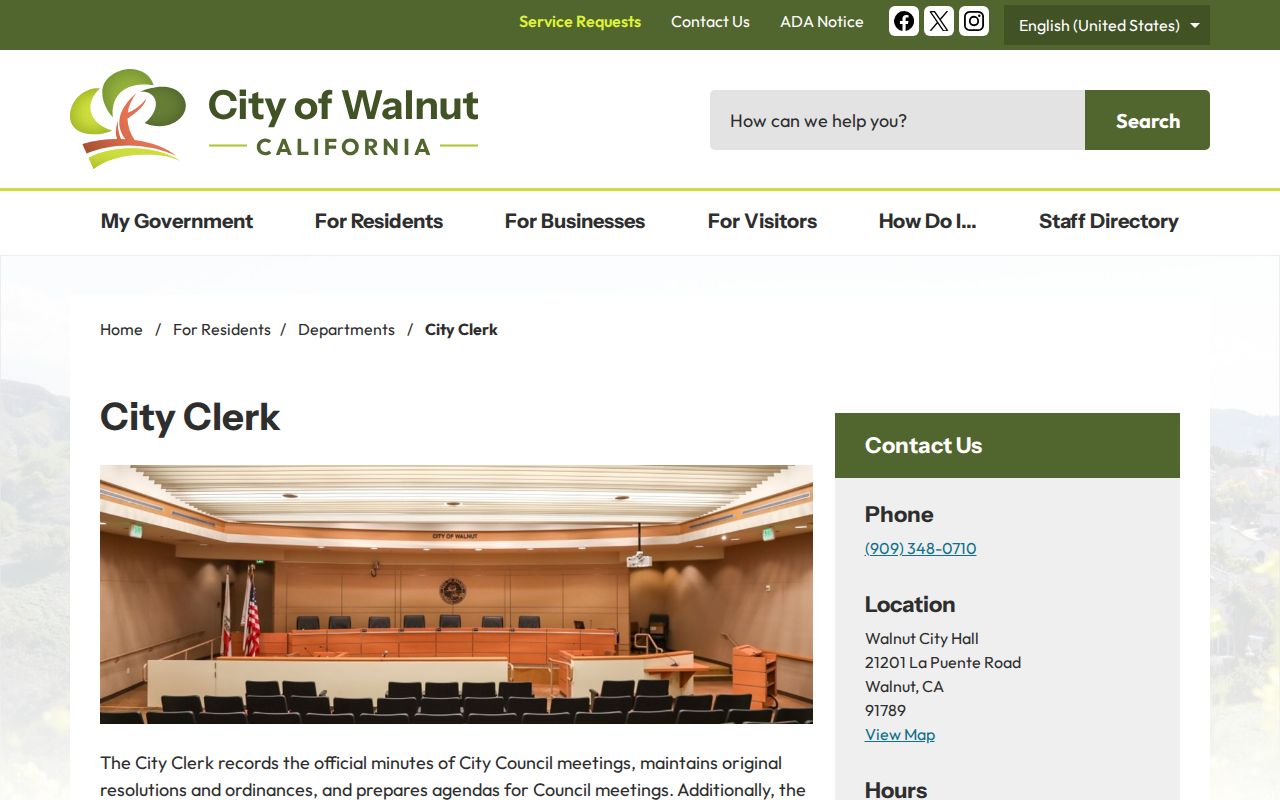
The captured city page confirms that municipal record access begins with Walnut's clerk rather than a countywide portal.
CPRA Terms for Walnut Records
California's access law is the California Public Records Act, now codified in Government Code title 1, division 10, beginning at section 7920.000. Any person may ask to inspect or obtain a copy of an agency record. Agencies may point first to material already online, then search and review records that require a request.
- Custodian
- The agency or office responsible for keeping and responding for a record.
- Index
- A finding aid that identifies a filing; it is not necessarily the document image.
- Certified copy
- An official copy authenticated by the issuing office, often with a separate fee.
- Exemption
- A legal basis to withhold all or part of a record from disclosure.
Prompt access is required. The familiar 10-day period is the time for an initial determination, not a promise that every set of responsive pages will be produced in ten days. Unusual circumstances can support an extension. Agencies may charge direct duplication costs or a fee set by another statute.
Request Walnut Open Records
Walnut City Clerk accepts requests by phone at (909) 348-0710 or (909) 348-0711, by email at tdedios@cityofwalnut.org, in person, or through the linked PDF form. The city has no comprehensive searchable records portal. For RR/CC material outside a standard deed or certificate service, the RR/CC NextRequest center accepts new requests and lets visitors browse prior requests.
The request center is a fallback for agency material, not a substitute for CivilIndex, the vital application, or an in-person deed index appointment.
- Name the custodian. Decide whether the record came from Walnut, an LA County office, the court, or a California agency.
- Check the published route. Use the official index, application, office terminal, or archives channel when one exists.
- Describe the file. Give a record type, department, subject, and useful date range. Do not ask an agency to answer a broad research question.
- Choose delivery and copy type. State whether inspection, an electronic copy, paper pages, or certification is needed.
- Review the response. Narrow an overbroad request, ask for the exemption supporting any withholding, and follow the agency's CPRA review route.
Walnut building files have their own direct channel. Inspection scheduling uses (909) 598-5241 and asks for the project address, contact information, and type of inspection. Code matters use the city service request or Code Enforcement phone path.
Limits on Walnut Open Records
Privacy rules remain attached to the record. Safe at Home can replace or shield a participant's residential address. Recorded documents may redact Social Security numbers and other sensitive identifiers. Home-address protections are also the reason RR/CC cites for keeping its real-estate index off the internet.
Some files are only partly open. A court index may show case metadata while sealed pleadings stay closed. A vital application may offer an informational copy but not an identity-valid authorized copy. Law-enforcement agencies can separate releasable facts from active-investigation, victim, or juvenile details.
Lawful personal use. Official access supports genealogy, estate work, consumer safety, and civic oversight. Never use disclosed information to stalk, harass, threaten, or harm anyone.
A denial should identify the legal basis for withholding. Ask whether redaction, inspection, a narrower date range, or a different custodian would allow partial access. That approach keeps the request focused while respecting the protections California law requires.